








Nirmal Purja (Nimsdai): The Man Who Made the Impossible Possible

- Nirmal “Nimsdai” Purja is a name that has become almost synonymous with courage, determination and high-altitude mountaineering.
- His journey from a young boy in Nepal to one of the world’s most recognised mountaineers is not an ordinary success story.
Nirmal “Nimsdai” Purja is a name that has become almost synonymous with courage, determination and high-altitude mountaineering. His journey from a young boy in Nepal to one of the world’s most recognised mountaineers is not an ordinary success story.
It is a story about believing in yourself when other people doubt you, finding solutions instead of excuses, and continuing forward when the conditions seem impossible.
For Nimsdai, climbing mountains was never only about reaching a summit. It was about testing the limits of human potential.
His famous message, “Nothing is impossible,” became the foundation of his extraordinary career.
From Nepal to the World’s Highest Mountains
Nirmal Purja was born in Dana, Nepal, in the Dhaulagiri region and grew up in Chitwan. He came from a family with a strong military tradition.
As a young man, he followed a path that would eventually prepare him for some of the world’s most dangerous environments.
In 2003, at just 18 years old, he joined the British Gurkhas. He later became a member of the UK’s elite Special Boat Service (SBS).
His military career lasted around 16 years.
Those years taught him discipline, teamwork, physical endurance and, perhaps most importantly, how to remain calm when things go wrong.
That training would later become extremely valuable in the Himalayas.
Discovering a New Purpose
Although Purja had a successful military career, mountaineering gradually became a major part of his life.
His first 8,000-metre summit was Dhaulagiri, which he climbed in 2014.
The experience changed his perspective.
He began to realise that he was capable of performing at extreme altitude, and eventually he developed an ambition that seemed almost unbelievable.
He wanted to climb all 14 mountains above 8,000 metres.
But he didn’t want to take several years to do it.
He wanted to complete them in just seven months.
Project Possible: 14 Peaks in Seven Months
In 2019, Nirmal Purja launched his most ambitious project, known as Project Possible 14/7.
The objective was simple to explain but incredibly difficult to accomplish:
Climb all 14 of the world’s 8,000-metre peaks in seven months.
These mountains include:
- Mount Everest — 8,848.86 m
- K2 — 8,611 m
- Kangchenjunga — 8,586 m
- Lhotse — 8,516 m
- Makalu — 8,485 m
- Cho Oyu — 8,188 m
- Dhaulagiri — 8,167 m
- Manaslu — 8,163 m
- Nanga Parbat — 8,126 m
- Annapurna I — 8,091 m
- Gasherbrum I — 8,080 m
- Broad Peak — 8,051 m
- Gasherbrum II — 8,035 m
- Shishapangma — 8,027 m
Climbing even one of these mountains is considered an enormous achievement.
Purja wanted to climb all fourteen.
And he wanted to do it at extraordinary speed.
Many people questioned whether the plan was realistic.
But Purja had a simple response to doubt: believe in the goal and find a way to make it happen.
“Nothing Is Impossible”
The phrase “Nothing is impossible” became closely associated with Nimsdai and Project Possible.
For him, it wasn’t just a motivational slogan.
It represented a way of thinking.
When people said that his seven-month target was impossible, he didn’t spend his energy arguing with them. Instead, he focused on preparation, logistics, weather, teamwork and execution.
His philosophy can be summed up simply:
Don’t start with the question, “Can I do it?” Start by asking, “How can I do it?”
That difference in mindset became one of the defining characteristics of his career.
The Historic 189 Days
Purja began Project Possible in April 2019.
His journey moved incredibly quickly.
He climbed Annapurna, followed by Dhaulagiri and Kangchenjunga.
Then came an extraordinary sequence in Nepal:
Mount Everest → Lhotse → Makalu
He completed Everest, Lhotse and Makalu within an astonishingly short period.
He then travelled to Pakistan and climbed:
Nanga Parbat → Gasherbrum I → Gasherbrum II → K2 → Broad Peak
The final part of the project included:
Cho Oyu → Manaslu → Shishapangma
On 29 October 2019, Nirmal Purja reached the summit of Shishapangma.
Project Possible was complete.
He had climbed all 14 of the world’s 8,000-metre mountains in just:
6 months and 6 days
or 189 days.
He had achieved his goal even faster than the seven months he had originally targeted.
The Everest, Lhotse and Makalu Achievement
One of the most incredible parts of Project Possible was not simply completing 14 peaks.
It was the speed.
Purja completed the combination of Everest, Lhotse and Makalu in 48 hours and 30 minutes.
He also established a remarkable speed record between Everest and Lhotse, completing the two summits within approximately 10 hours and 15 minutes.
These achievements demonstrated something important about his approach to mountaineering.
He wasn’t simply trying to survive the mountains.
He was trying to completely rethink what was possible on them.
K2: Another Historic Moment
Project Possible made Nimsdai internationally famous, but his story did not end there.
In January 2021, he became part of the Nepali team that achieved the first successful winter ascent of K2.
K2 is the second-highest mountain on Earth and is famous for its extreme technical difficulty and dangerous weather.
Winter makes the mountain even more unforgiving.
The successful ascent was a historic moment for Nepal and Himalayan mountaineering.
The Nepali team reached the summit together and sang the Nepali national anthem.
For many Nepalis, it became a moment of immense national pride.
It also demonstrated something Nimsdai had repeatedly tried to communicate:
Nepali climbers are not simply support workers in the Himalayas. They can also lead the world’s most ambitious expeditions.
More Than a Record
One of the most important things about Nirmal Purja’s story is that his goal was never only about breaking a record.
He wanted to change people’s perception of what Nepali climbers could achieve.
For generations, Nepal has been closely connected with Himalayan mountaineering. Sherpas, guides, porters and other mountain workers have played an essential role in expeditions.
But international attention has often focused on foreign climbers.
Purja wanted to change that.
He wanted the world to see Nepali mountaineers not just as people who support expeditions, but as world-class athletes, leaders and expedition specialists.
“I Want to Push the Perception of Human Potential”
One of the clearest ideas behind Project Possible was Purja’s desire to challenge people’s understanding of human potential.
He wanted to show that the boundaries we place around ourselves are not always real boundaries.
This idea is particularly powerful because his own life demonstrates it.
He was not born into a world of international fame.
He began his journey in Nepal, joined the Gurkhas, served in the military and gradually discovered mountaineering.
Then he attempted something that many people thought was unrealistic.
And he succeeded.
“Never Let Anyone Tell You That You Can’t Do Something”
Another message associated with Nimsdai is:
“Never let anyone tell you that you can’t do something.”
This does not mean ignoring reality or taking unnecessary risks.
Rather, it means not allowing somebody else’s opinion to become your own limitation.
There will always be people who tell you that your dream is too big, too difficult or unrealistic.
The important question is whether you have honestly tested your own potential.
Nimsdai’s life is an example of what can happen when a person refuses to let other people’s doubts decide their future.
“You’re Taught to Come Up With Solutions, Not Look for Excuses”
Purja has also spoken about the influence of his military training.
His approach was to solve problems rather than complain about them.
Mountains constantly create problems.
Weather can change.
Routes can become dangerous.
Equipment can fail.
A climber can become exhausted.
Plans can change within minutes.
At extreme altitude, there is very little room for careless decisions.
His military experience helped him develop a mindset of asking:
What is the solution?
rather than:
Why can’t this be done?
That mindset became one of the foundations of Project Possible.
Belief Comes First
Purja has emphasised the importance of believing in your objective.
His philosophy is simple:
If you don’t believe in your goal yourself, it becomes much harder to convince others to believe in it.
Before Project Possible became a world-famous achievement, it was simply an idea in his mind.
Other people could not see the future.
He could.
That is one of the lessons people can take from his story.
Every major achievement begins as something that exists only in someone’s imagination.
“This Project Is Not Just for Me”
Purja has also explained that Project Possible was bigger than his personal ambition.
He wanted his achievement to inspire other people.
He especially wanted people from ordinary or difficult backgrounds to see his story and understand that their starting point did not have to determine their destination.
His message was particularly meaningful for young people in Nepal.
A person doesn’t need to be born into wealth or privilege to have an extraordinary dream.
What matters is what they do with the opportunities they have.
Respect for the Mountains
Despite his record-breaking speed, Nimsdai has always recognised that mountains cannot be completely controlled.
The Himalayas are powerful and unpredictable.
At extreme altitude, even an experienced climber can become vulnerable.
The mountains can teach confidence, but they can also teach humility.
That balance is important.
Dream big—but respect what you are facing.
14 Peaks: Nothing Is Impossible
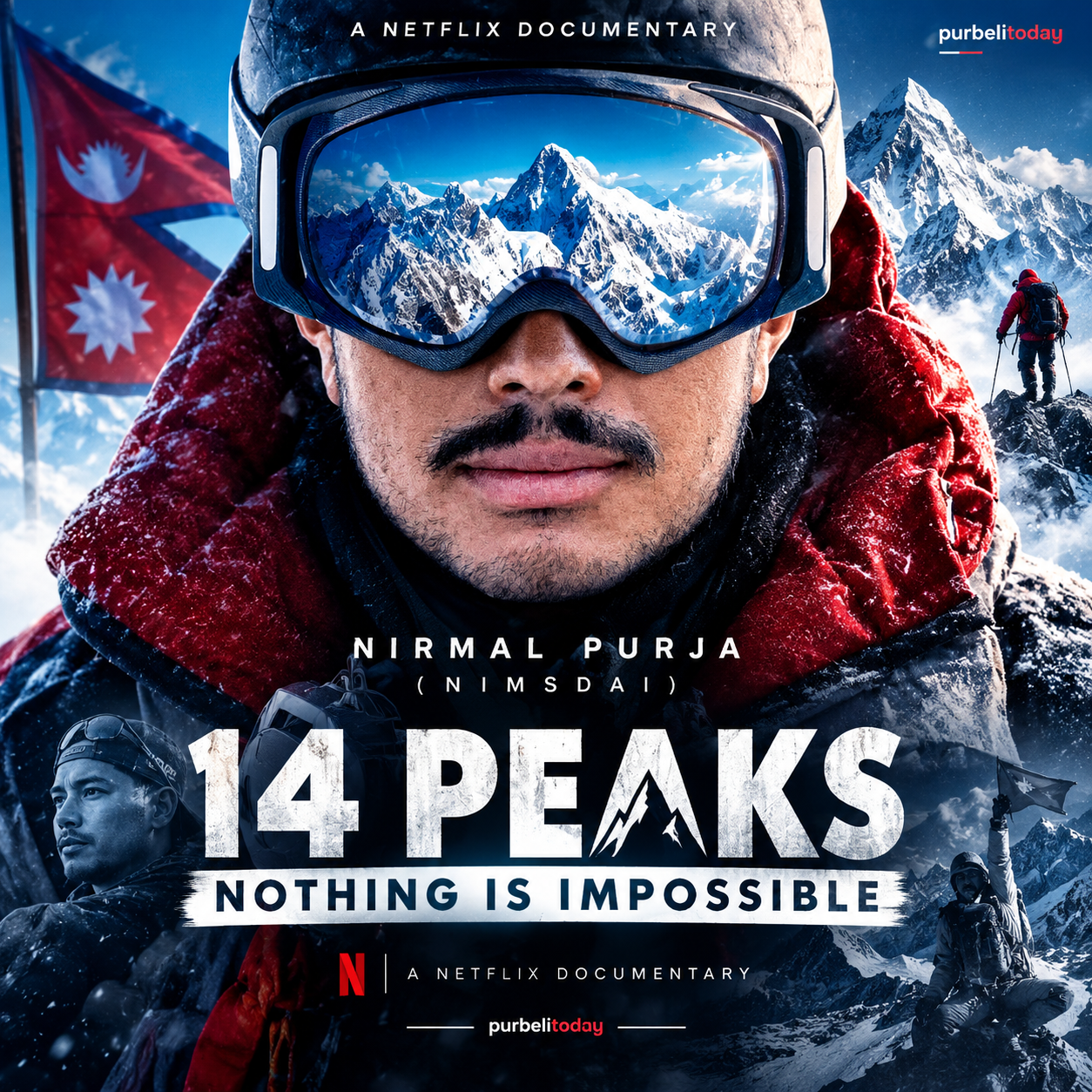
Nimsdai’s story reached an even larger international audience through the Netflix documentary 14 Peaks: Nothing Is Impossible.
The film follows his attempt to climb all 14 eight-thousanders and shows the enormous physical and emotional challenge behind the achievement.
For viewers who had never followed high-altitude mountaineering, the documentary provided an inside look at the risks, exhaustion, teamwork and determination involved.
More importantly, it introduced his philosophy to millions of people around the world.
The title itself captures the central message of his journey:
Nothing Is Impossible.
Beyond Mountaineering
Nimsdai’s influence also extended beyond climbing.
Through initiatives associated with the Nimsdai Foundation, he became involved in efforts connected with mountain communities, environmental work and the people who make Himalayan expeditions possible.
This is an important part of his legacy.
Mountaineering is not an individual sport in the simple sense.
Behind every successful expedition are guides, high-altitude workers, porters, cooks, rescue teams, logistics teams and countless others.
Purja’s work helped draw attention to the importance of the people working in the Himalayan climbing industry.
His Philosophy in Simple Words
If we take the major ideas associated with Nimsdai and put them together, his philosophy becomes very clear:
Believe in yourself.
Believe in your goal.
Prepare seriously.
Don’t make excuses.
Find solutions.
Don’t allow other people’s doubts to control you.
Work with your team.
Respect nature.
Give everything you have.
And when you achieve something, inspire the people coming after you.
These lessons are not only useful for mountaineers.
They can apply to business, education, sports, careers and everyday life.
The Difficult Side of His Story
Nimsdai’s career was not without controversy.
His aggressive style, speed-focused approach and public profile attracted criticism from some people within the mountaineering community.
There were also serious allegations of sexual misconduct reported against him in 2024, which Purja denied.
These controversies are part of the broader public record surrounding his life and should not be ignored when discussing his career.
At the same time, they are separate from the factual record of his mountaineering achievements.
A complete biography should recognise both the extraordinary accomplishments and the controversies surrounding a public figure.
His Final Expedition
In 2026, Nirmal Purja died during an expedition on Broad Peak in Pakistan after an avalanche.
He was 43 years old.
At the time, he was pursuing another ambitious mountaineering objective involving repeated ascents of the world’s 8,000-metre peaks.
His death was a tragic reminder of the reality behind high-altitude mountaineering.
No matter how experienced, strong or successful a climber becomes, the mountain always has the final word.
The Legacy of Nirmal “Nimsdai” Purja
Nirmal Purja’s life cannot be reduced to one number.
Yes, there is the incredible 189-day 14-peaks record.
There is the historic winter ascent of K2.
There are speed records on Everest, Lhotse and other mountains.
But his greater legacy is the mindset he represented.
He showed the world that a person from Nepal could dream on a global scale.
He challenged the traditional image of Himalayan mountaineering.
He brought greater international attention to Nepali climbers.
And he inspired millions of people to think differently about their own limitations.
His journey—from a young boy in Nepal, to a Gurkha soldier, to a British Special Forces operator, and finally to a record-breaking Himalayan mountaineer—is one of the most extraordinary stories in modern mountaineering.
Final Thoughts
The mountains Nirmal Purja climbed will remain where they have always been.
Everest will still rise above the Himalayas.
K2 will remain one of the world’s most dangerous mountains.
Annapurna, Dhaulagiri, Manaslu and the other eight-thousanders will continue to challenge future generations.
But the way people think about what can be achieved has changed.
That may be Nimsdai’s greatest contribution.
His story tells us that sometimes the biggest obstacle is not the mountain in front of us.
It is the voice inside our own head telling us that we cannot reach the top.
Nirmal Purja chose to challenge that voice.
He chose to believe.
He chose to prepare.
He chose to keep moving.
And for one extraordinary period in 2019, he made what seemed impossible look possible.
Nirmal “Nimsdai” Purja’s story is ultimately a story of courage, discipline, ambition, sacrifice and belief—a reminder that the first step toward achieving something extraordinary is having the courage to believe that it can be done.
“Nothing Is Impossible.”

प्रतिक्रिया


यो पनि पढौँ



यो पनि पढौँ


