







Moon and Venus Shine Together in the Sky: A Beautiful Celestial Event on September 14, 2026

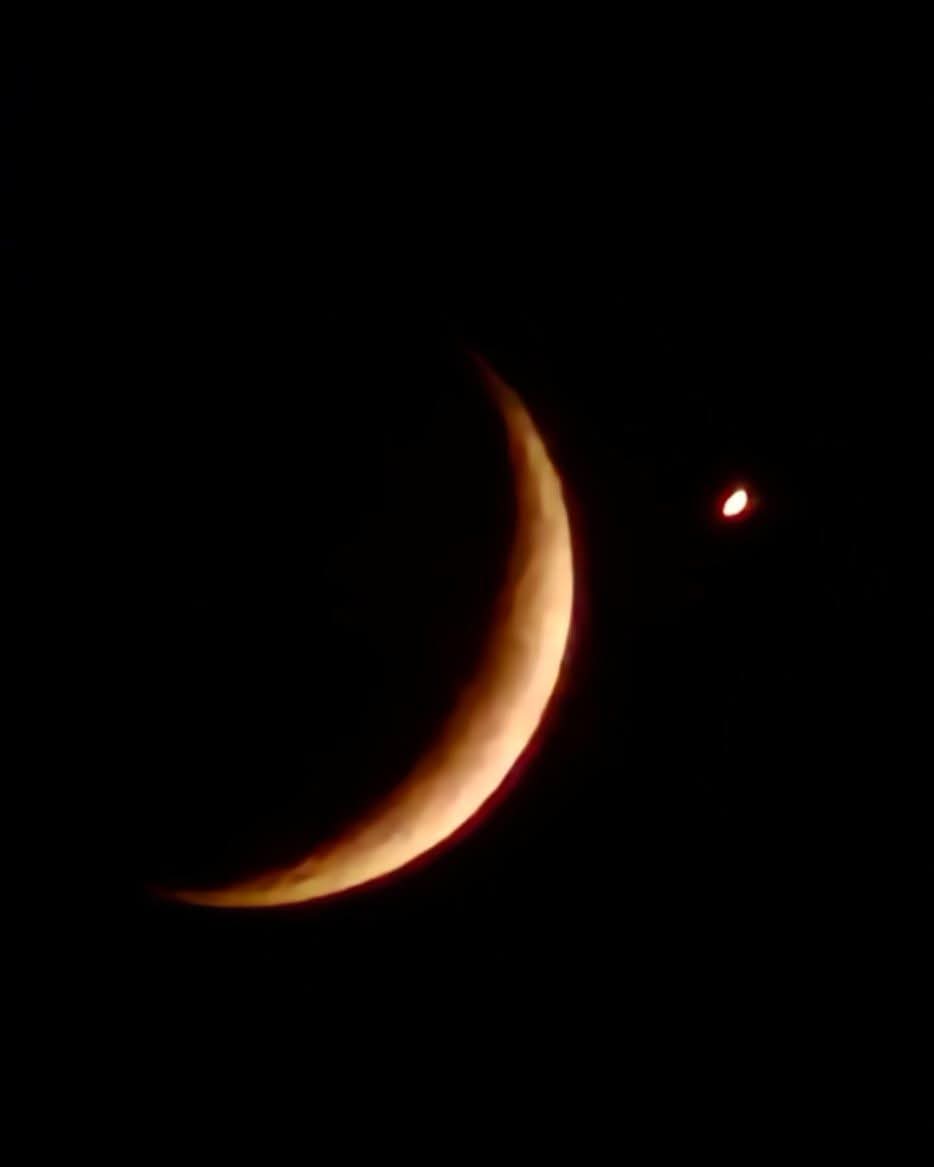
- Skywatchers around the world have a special reason to look toward the sky today, September 14, 2026, as the young crescent Moon and brilliant Venus appear remarkably close together.
- The pairing creates a beautiful celestial scene and is one of the notable sky events of September.
Skywatchers around the world have a special reason to look toward the sky today, September 14, 2026, as the young crescent Moon and brilliant Venus appear remarkably close together. The pairing creates a beautiful celestial scene and is one of the notable sky events of September.
A striking Moon–Venus pairing
The event is known astronomically as a conjunction or close approach of the Moon and Venus. From Earth, the two objects appear very close to one another in the sky, although they are actually separated by an enormous distance in space.
The Moon is Earth’s natural satellite, while Venus is a planet orbiting the Sun. Because of their different orbits and positions, they sometimes appear close together from our perspective on Earth. On September 14, the separation is particularly small—around half a degree, roughly comparable to the apparent width of the Moon in the sky.
Why does Venus look so bright?
Venus is often called the “Evening Star” because it can appear exceptionally bright around sunset. It is not actually a star; it is the second planet from the Sun.
Its thick cloud-covered atmosphere reflects a large amount of sunlight, making Venus one of the brightest natural objects visible in Earth’s sky after the Sun and Moon. During this event, Venus provides a brilliant point of light beside the delicate crescent Moon.
A very young crescent Moon
The Moon is only a few days past the September 11 new moon, so it appears as a thin waxing crescent. This makes the contrast between the slender Moon and brilliant Venus especially attractive for photographers and casual skywatchers.
For observers in Kathmandu, the Moon is expected to set around 7:51 p.m. local time, meaning the viewing opportunity after sunset is relatively short.
An even more interesting astronomical event
September 14 is not simply a close visual meeting. In some parts of the world, the Moon actually passes in front of Venus. This phenomenon is called a lunar occultation of Venus.
During an occultation, the Moon temporarily blocks Venus from view. The event is visible from parts of Asia, Africa and Europe, although the exact circumstances depend heavily on the observer’s location.
For many other locations, including areas where the occultation itself cannot be observed, the Moon and Venus can still appear close together and create a beautiful sight in the sky.
How to watch the Moon and Venus
For the evening view, you generally do not need a telescope. A clear view toward the western sky shortly after sunset is the most important requirement.
Try to find an open location without tall buildings, trees or mountains blocking the horizon. Because the Moon and Venus will be relatively low in the sky, the viewing window can be brief.
Binoculars can provide a closer look, but observers should never point binoculars or a telescope toward the Sun, especially while trying to find Venus during daylight.
A perfect opportunity for photography
The Moon and Venus appearing together also create an excellent opportunity for night-sky photography. A smartphone can capture the scene if the camera is pointed toward a clear western horizon soon after sunset.
Photographers may also include trees, mountains, buildings or a city skyline in the foreground to give the image a stronger sense of scale.
Why this event is special
Events like this remind us that the night sky is constantly changing. The Moon moves relatively quickly across the sky, while Venus follows its own orbit around the Sun. Their apparent meeting is therefore temporary.
On September 14, 2026, that cosmic geometry brings the two bright objects unusually close from our viewpoint on Earth, creating a scene that can be enjoyed without expensive astronomical equipment.
Final thoughts
Tonight’s Moon and Venus pairing is a simple but beautiful reminder of how fascinating our sky can be. A thin crescent Moon beside brilliant Venus can turn an ordinary evening into a memorable one.
So, if the sky is clear, look toward the western horizon shortly after sunset and take a moment to enjoy the view. 🌙✨🪐

प्रतिक्रिया


यो पनि पढौँ






यो पनि पढौँ